
16 Nov 2025, 2 Thessalonians 3: 6 – 13, Spiritual Muscles: Don’t Sit on the Unburnt Bench.
- Nov 17, 2025
- 8 min read
Good morning, everyone! It is so good to see you this morning! Let us look around and share the peace with one another. “Peace be with you.”
When I was doing my Master’s studies in Public Theology, our supervising professor took a small group on a four-day intensive retreat at a monastery. It was Hartzer Park. Today it is used as a retreat centre and a place for spiritual formation, but in the past, it was a large training house for the Sisters by the Catholic church.
When I arrived there, I was exhausted physically and spiritually. Ministry, study, a part-time job, and a growing family, all of it was pressing on me. So I had one simple goal for those four days: do nothing. Just rest.
We left behind the noise and the rush of the big city, along with everything on the to-do list. When we arrived there, we were so moved by the view, and I can still remember the long driveway leading up to the spiritual centre.
As I stepped out of the car, I heard only one thing: silence. It was exactly what my heart had been longing for. The old monastery buildings stood before us, shaped by many years of prayer and discipline. They weren’t grand or luxurious. Instead, they held a deep sense of simplicity and reverence. Even without anyone telling us, we could feel that this had once been a place where Sisters were formed.
Around the grounds were tall trees, a small pond in the centre, and a quiet path called “Sacred Path on to Mystery.” Everything felt completely removed from the world. The stillness, the deep silence, even the temperature and the smell of the air are still clear in my memory. I remember thinking, “I’ve finally come to a place where I can rest.”
After receiving warm smiles from the elderly Sisters who welcomed us, I was shown to my room. Inside, there was a small bed, a desk, a wash basin, and a narrow window. That was it, such a simple and almost humbling space. As I imagined the Sisters doing their spiritual formation in that very room, it felt just a little bit like a monastic cell.
After unpacking, I finally shouted to myself, “This is it. Four days of doing absolutely nothing!” And I jumped myself onto the bed. I closed my eyes for a moment, taking it all in.
And when I opened my eyes, right at that moment, I noticed a tiny plaque hanging on the wall in front of me.
I couldn’t help letting out a little, helpless laugh. “Oh dear, oh no.” It says: “Prayer is labour, Or labour is prayer.” It was a bit confusing, but anyway, it was a sentence built on just two words: “prayer and labour.”
Labour? I came here to get away from labour! Why am I seeing this now, every single time my eyes drift back to it?
And honestly, I found myself saying, “Lord, You’re not making this easy for me. I came here to escape labour, but You are calling me into spiritual labour!”
I even muttered to myself, “This must be their mistake. No wonder not many people want to become priests or Sisters.”
But as the first day passed, and then the second, I eventually surrendered. And I realised something important:
True rest is not simply doing nothing. True rest is entering into the labour that heals the soul. True rest restores my spiritual muscles and prepares them to be used again.
Because prayer is the labour of wrestling with our weakness, our unfaithfulness, and our fears. And through all of this, God builds in us the spiritual muscles that do not grow weary in doing what is right.
With that, today’s verse began to make new sense to me: “Never tire of doing what is right” (2 Thessalonians 3:13).
And the meals? Well, let’s just say they were simple. Very simple. Almost as if God knew I had come there to do absolutely nothing, so He gave me food to match, as if to say, “You didn’t do any labour today, you shall not eat!”
The Quiz: Why the Second Letter?
I wonder if you had a chance to see the little quiz I shared in the newsletter this week? Well, just in case some of you missed it, David is going to show on the screen. Here are the questions:
Why did Paul write two letters to the Thessalonians?
Why not just send one long message?
What happened between the first and second letters?
To make it easier, I prepared six multiple-choice answers. Alright, let’s raise our hands!
Because Paul didn’t finish everything he wanted to say in the first letter.
Because Paul had extra time while travelling.
Because the Thessalonian church misunderstood his first letter, causing confusion and division.
Because he wanted to encourage them again after planting another church.
Because the first letter got lost on the way.
Because some members said, “Paul, your letter was too hard to understand!”
And the correct answer is number 3! Because the Thessalonian church misunderstood Paul’s first letter, which led to serious confusion and disorder within the community.
So Paul had no choice but to write a second letter urgently to address the situation. (If you got it right, come and see me after the service, I’ll give you a coffee gift voucher. First four only!)
Originally, Paul may have needed to send only one letter to the church. But he ended up writing a second letter quickly. And the reason had to do with one particular part of his first letter: his teaching about Christ’s second coming.
Paul had written in that first letter, “The Lord will come like a thief in the night. Stay awake.” Look, His intention was to give them hope, hope that Christ would return, hope that God would renew their lives, and hope that a new creation was on its way. Unfortunately, this message was misunderstood in a very extreme way.
Some members began to think, “Jesus is coming soon, so let’s just wait.” They started saying, “Don’t work. Let’s gather, pray, and wait for the Lord.” Slowly, this thinking spread: “Labour is worldly. We should focus only on spiritual things!”
And eventually, some people said, “The things of this world don’t matter; Jesus will return soon anyway.”
So they depended on others, and they began to interfere in things that were not their responsibility. Of course, it made serious disorder within the church. This was totally out of line with Paul’s original intention. So when Paul heard what was happening, he was deeply concerned. “Let me explain this to you again!” That is why he had to write the second letter.
“Friends, do not misunderstand. Do not be shaken or frightened by talk about Christ’s coming. Listen! no one knows the day. So please return to your daily life. Go back to your work. Live each day faithfully while waiting in hope for the Lord. Take your responsibility as followers.”
With all this background, we can now understand why Paul worked with his own hands as an example, why Paul urged them not to live an unproductive life, not avoiding their daily work, why he even said, “If you are unwilling to work, you shall not eat,” and why he encouraged them, “never tire of doing what is good.”
Paul writes this second letter with a heart full of concern and love. And he gently but firmly teaches them not to escape into a spiritual dream world, not to hide from reality by saying they are “waiting for the Lord.” Because true faith is lived out in everyday life, in our work, in our duty, and in our relationships. Every new day is a gift God has given us, and we are called to live it with the meaning God intended for us. And this is the heart of today’s message.
The Unburnt Bench
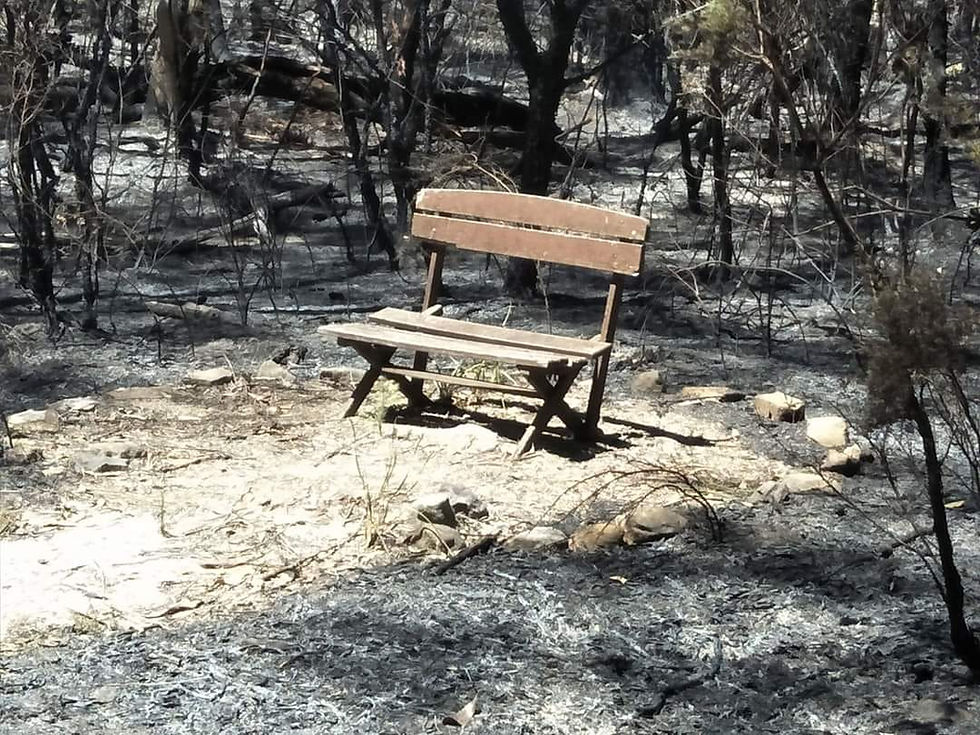
Brothers and sisters, let us look at the amazing image on the screen. As I mentioned in the newsletter, I wonder if you had a chance to reflect on this picture during the week. What has led your heart to ponder?
A friend shared this image on Facebook. This photo was taken in November 2019 at the Blue Labyrinth Bush Retreat in the Blue Mountains, during the historic bushfires. The fires swept through everything with devastating force, and this image left a deep impression on me.
As you can see, there stood a wooden bench, untouched, unburnt, and surrounded by destruction on every side. To some people, this might look like a miracle, God’s direct intervention. To others, it may simply be “coincidence.” But for me, my heart leans toward calling it a mystery, a grace of God.
And this is what I want to share with you today: as we shared last week, God is with us in all things. Even in this scene of a fierce fire, with a wooden bench left unburnt. Yes, Immanuel. Through the Holy Spirit. God Himself is present with us.
Whenever we witness moments like this, we naturally sense divine presence. And we begin to hope for that same grace in our own lives. Because we know that God is full of compassion, full of mercy, and endlessly gives us hope and love.
So I want to ask you today: how far does your reflection go when you see an image like this? How deeply do you allow it to speak into your life?
Here is an interesting part: as I continued to reflect on this image, along with Paul’s letter today, a different question arose in my heart:
“If I were ever in a situation like this, when the fire is rushing toward me, should I just sit on the bench and wait? If the fire were coming closer and closer, should I stay where I am? Or should I get up and run? Should I do everything I can to escape? Or should I fight with all my strength to put out the fire?”
We all know the answer. No matter how miraculous that bench appears, even if it is a symbol of protection, I must get up. I must move, run, protect myself, and do everything possible to survive.
If someone, a brother or sister, were sitting still in that place, would I encourage them to stay, or would I grab their hand and run away with them?
This is not simply a reflection on natural disasters. This is a question about our faith. And this question connects directly to Paul’s warning to the church in Thessalonica. Some believers were so overwhelmed by the belief that “The Lord will return soon, very soon” that they abandoned engaging with real Christian life. Perhaps they were thinking, “Jesus will save us. I believe in Him. Let us sit on the bench and wait. Let us lie down in bed!”
But Paul is confronting a spiritual laziness—a faith that waits passively and does nothing, hoping God will do everything.
And friends, as we come toward the end of this message, my mind goes back to that moment in the retreat house, lying on the bed, exhausted, determined to rest—only to look up and see that small plaque on the wall: “Prayer is labour.” God used that simple sentence to change me. I realised that prayer is not passive. Faith is not passive. Waiting for Christ is not passive. Even hope is not passive.
Love is the labour of turning our hearts toward God. Faith is the labour of standing again when we want to lie down. Hope is the labour of holding on when life feels heavy.
So yes, dream of Christ’s return, but don’t hide behind laziness.
Trust in God and believe in Immanuel, but don’t abandon the place where God has called us to live and serve.
And friends, if we ever find ourselves sitting on that unburnt bench, or lying down on a bed of comfort, let us rise. Let us move. Because God often protects us as we do our best, as we step into our responsibilities, as we choose what is good.
And as we stand and walk in faith, we will find a holy stillness, a quietness of heart where we can truly await the coming of our Lord Jesus Christ.
May this message reach the one who needs it today, the one who longs to stand again, to move again, to live again in the grace of our Lord.
Amen.


